
Beyond the Billionaire Backlash: Jeff Bezos and the Infrastructure of Modern American Life
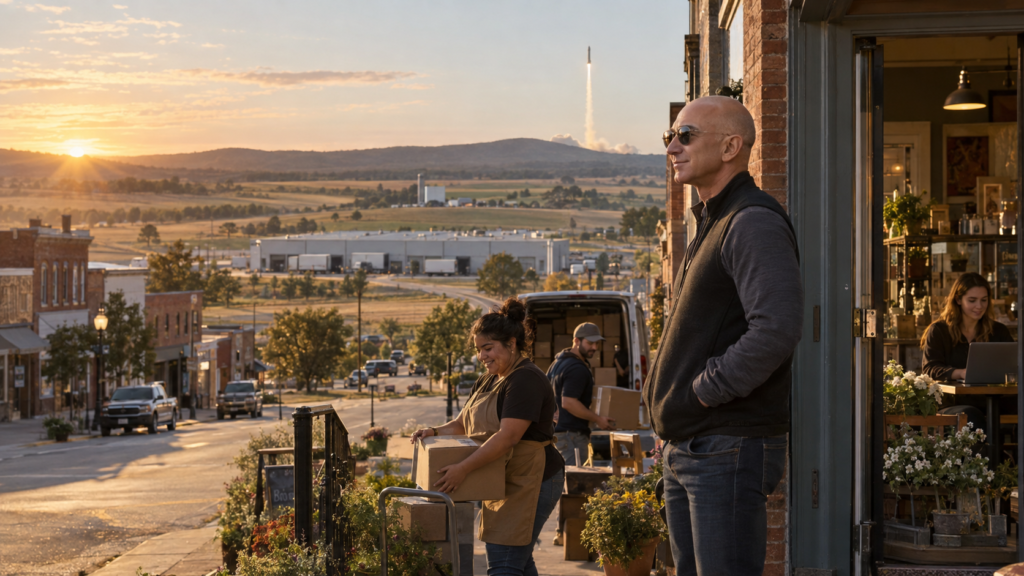
Why the Amazon founder’s economic, technological, philanthropic, and space legacy deserves a more serious assessment
By Dr. Noble Nwigwe, PhD, MHA
Founder and CEO, Remote Practice Managers, Inc.
Jeff Bezos has sometimes been portrayed as one of the world’s most disliked billionaires. Such rankings may attract clicks, but they rarely produce serious analysis. They reduce a complicated individual—and an extraordinarily consequential group of companies—to a caricature based largely on wealth, corporate scale, and public resentment.
Criticism of powerful business leaders is appropriate. Amazon should be held accountable for how it treats employees, competes with other businesses, handles consumer data, and exercises its enormous market influence. No corporation or billionaire should be beyond scrutiny.
But scrutiny is not the same as reflexive condemnation.
A fair assessment of Jeff Bezos must consider not only his wealth, but also what he built, what his companies made possible, the infrastructure they created, the risks they absorbed, and the opportunities they opened for millions of people.
Measured by those standards, Bezos belongs among the most consequential entrepreneurs in modern American history. Alongside the Walton family’s transformation of retail distribution, Bezos helped reconstruct the commercial, technological, and logistical architecture of the United States.
Amazon did not merely create a convenient place to shop. It built a nationwide system connecting consumers, workers, entrepreneurs, manufacturers, authors, software developers, healthcare organizations, government agencies, and rural communities.
That accomplishment deserves a more thoughtful examination.
1. Amazon Helped Democratize Access to Goods
For Americans living in large cities, retail choice is often taken for granted. Urban consumers may have dozens of stores, pharmacies, specialty retailers, and service providers within a few miles.
Rural Americans frequently face a different reality.
Many small communities have limited retail competition, fewer specialty stores, longer driving distances, and reduced access to certain household, medical, educational, and business products. For an elderly person, someone living with a disability, a family without reliable transportation, or a rural entrepreneur, a 30- or 50-mile shopping trip is not a minor inconvenience.
Amazon dramatically reduced this geographic disadvantage.
Its fulfillment and delivery network made millions of products accessible to Americans regardless of whether they lived near a major commercial center. A resident of rural Georgia, Montana, West Virginia, or North Dakota could increasingly obtain products that had previously been difficult, expensive, or time-consuming to acquire.
This represents more than convenience. It is a form of economic inclusion.
Access to books, computers, replacement parts, medical supplies, educational materials, tools, and business equipment can directly influence a person’s productivity and quality of life. Amazon helped narrow the practical distance between rural and metropolitan America.
In 2025, the company announced an additional $4 billion investment in its rural delivery network, projecting that the expansion would support more than 100,000 jobs and bring faster delivery to thousands of smaller communities. Amazon’s rural-delivery investment announcement illustrates how digital commerce is increasingly being supported by physical infrastructure in places that were historically underserved.
This does not mean Amazon alone can solve rural America’s economic challenges. Broadband availability, healthcare access, education, transportation, and local investment remain essential. But Amazon has undeniably made rural communities more connected to the national marketplace.
2. Amazon Created Employment Beyond Major Cities
Amazon’s employment impact is often discussed only in terms of warehouse jobs. Those jobs matter, but the company’s employment footprint is much broader.
Its operations support work in:
- Fulfillment and distribution
- Transportation and last-mile delivery
- Aviation and logistics
- Construction and facility maintenance
- Software engineering
- Cybersecurity
- Cloud computing
- Artificial intelligence
- Advertising and media
- Entertainment production
- Customer service
- Corporate administration
- Small-business operations
Amazon reports that it invested more than $340 billion in the United States during 2025 and has contributed more than $1.8 trillion to the American economy since 2010. The company also reports substantial investment across all 50 states, including small towns and rural communities. Amazon’s 2025 Economic Impact Report describes both its direct employment and the additional economic activity generated around its facilities.
The presence of a major fulfillment center can attract contractors, restaurants, transportation companies, housing development, maintenance providers, professional services, and other supporting businesses. Amazon cites research suggesting that, five years after a large fulfillment center opens, the surrounding area experiences measurable increases in small businesses and labor-force participation.
Corporate economic-impact studies should, of course, be evaluated with appropriate independence. Nevertheless, the scale of Amazon’s capital investment, payroll, construction, and procurement cannot reasonably be dismissed.
For many Americans without advanced degrees, Amazon has also provided an entry point into the formal economy. Not every position becomes a lifelong career, but a job can still provide immediate income, benefits, experience, stability, and a platform for advancement.
The deeper policy question should not be whether these jobs are perfect. Few jobs are. The appropriate question is how employers, workers, communities, and regulators can continuously improve safety, compensation, training, mobility, and dignity within these workplaces.
3. Amazon Gave Small Businesses a National Storefront
Amazon is often accused of destroying small businesses. In some markets, that criticism deserves consideration. Large platforms can place pressure on independent retailers, and sellers may become highly dependent on rules, fees, algorithms, and advertising systems they do not control.
Yet there is another side to the story.
Amazon also gave small businesses access to a national—and sometimes international—customer base that would have been nearly impossible for them to reach independently.
Before digital marketplaces, a small business might have needed multiple storefronts, large advertising budgets, warehouse capacity, payment infrastructure, and complex shipping arrangements to sell nationwide. Amazon placed many of those capabilities inside a single platform.
According to Amazon, independent sellers now account for more than 60% of sales in its store. In 2025, these sellers reportedly employed more than two million people in the United States, while over 75,000 independent sellers exceeded $1 million in annual Amazon sales. Amazon’s Small Business Empowerment Report also reports that American independent sellers averaged more than $375,000 in annual platform sales.
These are Amazon’s own figures and should be identified as such. But they demonstrate a reality that critics sometimes ignore: Amazon is not simply a retailer competing against entrepreneurs. It is also infrastructure used by entrepreneurs.
Through Fulfillment by Amazon, marketplace listings, payment processing, advertising, inventory tools, and customer access, a person can transform an idea developed at a kitchen table, garage, farm, workshop, or small office into a scalable business.
That is individual empowerment.
The platform is imperfect, and seller grievances about fees, competition, account suspensions, and platform control must be taken seriously. However, the appropriate response is to improve transparency, competition, and seller protections—not to pretend that the entrepreneurial access Amazon created has no value.
4. Amazon Web Services Became Part of America’s Digital Backbone
Amazon’s most transformative contribution may not be the familiar shopping platform. It may be Amazon Web Services.
AWS helped popularize cloud computing by allowing organizations to access computing power, storage, databases, security services, analytics, and artificial-intelligence capabilities without building expensive data centers of their own.
This fundamentally changed the economics of starting and operating a business.
A new company no longer needed millions of dollars in technology infrastructure before testing an idea. A healthcare organization could deploy secure applications more rapidly. A nonprofit could scale a digital program. A government agency could modernize selected services. A software developer could build a global application from a laptop.
AWS became a foundational platform for startups, hospitals, universities, banks, media companies, public agencies, and established corporations.
This is especially relevant in healthcare. Cloud infrastructure has supported telehealth, clinical analytics, remote work, patient-engagement platforms, revenue-cycle technologies, and artificial-intelligence applications. Organizations such as Remote Practice Managers operate within a business environment made possible by the broader transition toward cloud-based systems, distributed teams, and digital service delivery.
AWS did not invent every component of cloud computing, but it helped turn cloud infrastructure into an accessible utility. Much as electric grids allowed businesses to use electricity without owning power plants, cloud computing enabled businesses to use advanced technology without owning data centers.
That is not merely a successful product. It is a structural contribution to the modern economy.
5. Amazon Changed What Individual Entrepreneurs Could Become
Bezos’s larger legacy involves lowering barriers.
Amazon lowered barriers between consumers and products. AWS lowered barriers between entrepreneurs and computing infrastructure. Kindle lowered barriers between writers and readers. Amazon Marketplace lowered barriers between sellers and national markets. Fulfillment services lowered barriers between small businesses and sophisticated logistics.
An individual can now:
- Publish a book without waiting for a traditional publisher.
- Sell a product nationally without opening multiple stores.
- Build a software company without constructing a data center.
- Reach specialized customers from a rural location.
- Use logistics infrastructure that was once available only to major corporations.
- Create digital content and distribute it to a global audience.
Not every participant succeeds, and Amazon benefits financially from every ecosystem it creates. Nevertheless, profit and empowerment are not mutually exclusive. Many of history’s most important innovations became sustainable precisely because someone developed a profitable system for delivering them at scale.
The question should not be whether Bezos became wealthy. The question should be whether millions of other people gained useful capabilities from the systems he helped build.
The evidence suggests that they did.
6. Amazon Strengthened America’s Logistics Capacity
The COVID-19 pandemic revealed how important logistics infrastructure had become.
When many physical establishments were closed or operating under restrictions, digital commerce helped households obtain food, protective equipment, household necessities, work supplies, and other essential products. Amazon’s network was not flawless, but its scale provided a form of national resilience during an extraordinary disruption.
The company’s warehouses, aircraft, delivery stations, software systems, inventory forecasting, and last-mile partnerships constitute a privately built logistics network of historic scale.
This infrastructure continues to have national significance. It supports commerce, employment, disaster response, small-business distribution, and the movement of goods into communities that might otherwise receive limited service.
There are legitimate debates about market concentration and whether such infrastructure gives one corporation too much power. Those concerns should be addressed through intelligent competition policy, transparent regulation, and strong protections for consumers, workers, and sellers.
But regulation should distinguish between preventing abuse and punishing competence.
America should not become so suspicious of corporate scale that it loses the ability to recognize the national value of systems that actually work.
7. Blue Origin Is Investing in America’s Space Future
Jeff Bezos’s ambitions extend beyond commerce.
Through Blue Origin, he has invested heavily in reusable launch vehicles, rocket engines, space research, human spaceflight, and lunar capabilities. Blue Origin’s stated objective is to reduce the cost of reaching space and build infrastructure that could support future generations beyond Earth.
The company’s New Shepard system was designed for reusability, with Blue Origin reporting that nearly 99% of the vehicle’s dry mass is reusable. Blue Origin’s New Shepard program has carried people and scientific payloads beyond the Kármán line.
More importantly for America’s long-term capabilities, the much larger New Glenn launch vehicle is designed to carry substantial payloads into orbit using a reusable first stage. In November 2025, New Glenn’s second mission deployed NASA’s ESCAPADE spacecraft and successfully landed its first stage at sea. Blue Origin’s NG-2 mission report marked an important demonstration of reusable heavy-lift capability.
Space investment is sometimes ridiculed as a billionaire’s hobby. That criticism overlooks history.
Satellite communications, GPS navigation, weather forecasting, climate observation, national defense, precision agriculture, disaster monitoring, and many everyday technologies depend on space infrastructure. A robust commercial space sector strengthens American scientific leadership, industrial capacity, technological innovation, and national security.
Blue Origin also contributes to a competitive space economy. The United States benefits when multiple companies can develop launch systems, engines, lunar technologies, and orbital infrastructure. Depending on a single provider would create technological and strategic vulnerability.
Bezos’s investment in space should therefore be understood not merely as personal adventure, but as patient capital directed toward a frontier with enormous national and human consequences.
8. Philanthropy Should Be Evaluated by Its Results
Bezos has also been criticized for not giving away enough of his wealth or for beginning major philanthropy later than other billionaires.
Debating the responsibilities of extreme wealth is legitimate. However, serious analysis should also recognize the magnitude and direction of the commitments that have been made.
The Bezos Earth Fund represents a $10 billion commitment to address climate change and protect and restore nature. Its work includes conservation, food-system transformation, environmental justice, clean-energy development, urban greening, satellite monitoring, and decarbonization of major industries. The Bezos Earth Fund describes its strategy as combining grants, technology, partnerships, and innovative financing.
Its American initiatives include hundreds of millions of dollars directed toward green spaces and environmental improvement in underserved urban communities. The fund has also supported wildfire detection, electric school buses, food-system innovation, and climate-resilient technologies.
Through the Bezos Day One Fund, Bezos has committed resources to organizations serving families experiencing homelessness and to the development of tuition-free preschools in underserved communities.
Philanthropy does not erase corporate responsibility. A charitable contribution should never be used as immunity from criticism. But neither should philanthropy be dismissed simply because the donor is wealthy.
The proper standard is impact: Are the investments serious? Are they reaching capable organizations? Are they producing measurable public benefits? Are they addressing problems at a meaningful scale?
Those are better questions than whether the donor fits someone’s preferred public image.
9. The Criticisms of Amazon Cannot Simply Be Ignored
A credible defense of Bezos must acknowledge that Amazon’s history includes genuine controversies.
The Federal Trade Commission and state partners have alleged that Amazon used anticompetitive strategies to preserve monopoly power and disadvantage sellers and rivals. These remain serious legal and policy matters, and allegations should not be presented as final judicial findings unless a court has ruled on them. The FTC’s Amazon competition case nevertheless demonstrates the scale of regulatory concern.
Amazon has also faced criticism concerning warehouse productivity expectations and workplace injuries. Following federal investigations and litigation, the company entered a 2024 settlement with the Occupational Safety and Health Administration requiring corporate-wide ergonomic risk assessments, controls, training, employee-reporting mechanisms, and ongoing monitoring. The Department of Labor’s settlement announcement documents both the government’s concerns and the corrective measures Amazon agreed to implement.
These are not minor matters. Workers are human beings, not units of productivity. Rapid delivery should never come at the expense of safety, dignity, or reasonable working conditions.
Amazon should also be expected to provide fair treatment to sellers, transparent platform rules, responsible use of data, genuine consumer choice, and meaningful avenues of appeal.
But criticism becomes intellectually weak when it refuses to acknowledge positive impact. A company can create enormous value and still require reform. A founder can be historically consequential without being morally perfect.
We should be capable of holding both ideas at once.
10. Why Billionaire “Hatred” Is an Inadequate Framework
The language of hatred is emotionally powerful but analytically empty.
It encourages people to evaluate economic leaders based on personality, wealth, political symbolism, or internet narratives rather than outcomes. It also promotes the mistaken idea that wealth must necessarily represent value taken from society rather than value created through ownership in a productive enterprise.
Bezos did not become wealthy because Americans were forced to purchase Amazon stock. His wealth primarily grew because a company he founded became extraordinarily valuable. Investors believed that Amazon’s logistics network, technology, customer relationships, cloud infrastructure, and future earnings were worth more over time.
That does not settle questions about taxation, labor policy, corporate power, or social responsibility. It does, however, matter when evaluating how the wealth was generated.
The better public conversation is not, “Do we like billionaires?”
It is:
- What did they build?
- How did they acquire their wealth?
- Who benefited from their enterprises?
- Who may have been harmed?
- What responsibilities accompany their power?
- What reforms are necessary?
- What long-term capabilities did they create for the country?
When Bezos is evaluated through this more disciplined framework, his record becomes far more substantial than the popular caricature suggests.
11. Bezos’s Broader Contribution to America
Jeff Bezos helped America accomplish several things simultaneously.
He helped build a commercial bridge between rural and urban communities. He expanded access to goods. He created direct and indirect employment. He gave entrepreneurs a national marketplace. He helped make cloud computing an accessible utility. He funded a major American space enterprise. He invested in climate initiatives, early education, and services for families experiencing homelessness.
He also demonstrated something important about the American system: an idea that begins with limited resources can, through discipline, experimentation, customer focus, and long-term investment, become infrastructure used by an entire nation.
Amazon’s story is therefore larger than Jeff Bezos. It is about American innovation, risk-taking, capital formation, logistics, technology, and the ability to build at scale.
Bezos should not be worshipped. No business leader should be.
But neither should he be casually reduced to a villain because his success has become almost incomprehensibly large.
Conclusion: Judge the Builder by the Full Record
History should evaluate builders by their total impact—not by social-media popularity contests.
Jeff Bezos and his companies have altered retail, logistics, publishing, entrepreneurship, cloud computing, artificial intelligence, entertainment, and space exploration. They have expanded consumer access, particularly in communities where traditional retail options are limited. They have enabled individuals and small businesses to use systems once reserved for the largest corporations.
At the same time, Amazon must continue improving worker safety, labor relations, marketplace fairness, consumer protection, and responsible corporate governance. Great scale must be matched by great responsibility.
The most reasonable conclusion is therefore neither blind admiration nor reflexive hatred.
It is recognition.
Jeff Bezos is one of the most consequential business builders of the modern era. His companies have become woven into the economic and technological fabric of the United States. Their shortcomings deserve accountability, but their contributions deserve intellectual honesty.
America should continue asking hard questions of Bezos and Amazon. But it should also recognize what was built: a vast system of commerce, technology, employment, entrepreneurship, logistics, and exploration that has changed what millions of Americans can access, create, sell, learn, and imagine.
That is not a small legacy.
It is an American legacy.
About the Author
Dr. Noble Nwigwe, PhD, MHA, is the founder and CEO of Remote Practice Managers, Inc., a healthcare management and practice-optimization company helping medical organizations improve operations, revenue-cycle performance, technology adoption, workforce effectiveness, and patient access. His work focuses on evidence-based management, Lean process improvement, digital transformation, remote practice administration, and the responsible application of artificial intelligence in healthcare.
Recent Comments